Tuesday, January 22, 2008

International Theatre and Film Books to Offer Life Behind the Metaphor Exclusively in Amsterdam

We're pleased to announce that International Theatre and Film Books (ITFB) retail store will soon be carrying Life Behind the Metaphor for interested readers in Amsterdam. Life Behind the Metaphor examines Nureyev's collaboration with the Dutch National Ballet's long-time Artistic Director Rudi van Dantzig during the company's U.S. tour in 1978. And the historic book presents a significant photographic reference for admirers of Dutch ballet. Our partnership with ITFB is a wonderful opportunity to bring the book to the Netherlands. Look for Life Behind the Metaphor on the ITFB Web site soon. You can contact our new retail partner at:

International Theatre & Film Books
Leidseplein 26
1017 PT Amsterdam
(tel) 020-6226489
(fax) 020-6272148
(e-mail) info@theatreandfilmbooks.com
(web) www.theatreandfilmbooks.com

UPDATE: Life Behind the Metaphor is now available on the ITFB Web site. Take a look and order a copy!

Friday, January 18, 2008

The Dutch National Ballet's Friends Magazine Reviews Life Behind the Metaphor


More media news: The coordinator of the Friends Circle of the Dutch National Ballet, Wouter Hos, wrote about the book in the January issue of the DNB's Friends Magazine. Dutch readers can check out the article in PDF format here.

Tuesday, January 15, 2008

Dance Magazine Recommends Life Behind the Metaphor In Its December 2007 Issue

We're pleased to note that Dance Magazine included Life Behind the Metaphor in its article "Gift Ideas for Dance Lovers." Reviewer Kina Poon calls the book "beautifully produced," saying:

While Nureyev inevitably shines with his glorious ballon and charismatic looks, his sound bites are also pungent. Among other gems, there's Nureyev insisting that the photographer never crop out the stage floor from under his soaring jete. His quotations also reveal periods of darkness and his tumultuous relationship with [v]an Dantzig. Equally remarkable is [v]an Dantzig's unaffected prose. His musings on being airborne are framed by shots of dancers soaring off a diving board, arms out-stretched, toes pointed.
It's great to see that the dance community appreciates the quality and uniqueness of Life Behind the Metaphor!

You can read the article in PDF format here.

Wednesday, November 28, 2007

Life Behind the Metaphor reviewed by Library Journal!

We just saw that, in September, Library Journal reviewed our book of photographs of legendary dancer Rudolf Nureyev, Life Behind the Metaphor:

Rudolf Nureyev leaps off the pages in this stunning collection of 80 black-and-white photographs from a 15-year period during which he toured the United States with the Dutch National Ballet (DNB). Drawn from the archives of the New York Public Library for the Performing Arts, the pictures chronicle the legendary dancer in such ballets as Le Corsaire, Four Schumann Pieces, and Afternoon of a Faun. Van Dantzig (former artistic director, DNB) allowed Urban to photograph Nureyev and company members on and off stage, and because Nureyev's contracts prohibited performance photos, many of these images are not only unique but also rare. In this coffee-table art book, the photographs are printed on archival-quality paper, and the text includes comments from van Dantzig, Nureyev, and Urban. Anyone who saw Nureyev dance will relive the experience with these photographs; those who didn't will wish they had. Highly recommended for dance and performing arts collections. [There will be an exhibit of selected materials from the NYPL collection at Lincoln Center this fall.—Ed.]—Carolyn M. Mulac, Chicago P.L.

Life Behind the Metaphor featured in Time Out New York's Gift Guide!

Time Out New York has featured our book, Life Behind the Metaphor, in the Dance section of its holiday Gift Guide. Go check out the mention, and see what other great gifts they recommend for the dance enthusiast on your shopping list!

Wednesday, October 17, 2007

What do YOU think?

Now that Life Behind the Metaphor has been released, we'd love to hear from you about your reactions to the book, and your reminiscences of seeing Nureyev dance. Please, comment below!

Sunday, October 14, 2007

Blog mention at the Stanford School of Business

Jan Driscoll posted a nice mention of Roger and Life Behind the Metaphor over at the Stanford School of Business's Jackson Library Blog. Go check it out!

Wednesday, October 10, 2007

Le Corsaire

Thanks to blogger Lula Bites for this YouTube clip of Nureyev's solo from Le Corsaire (taken from the Bridcut BBC/PBS documentary, I think):


UPDATE: Lula notes that, "I think, but I am not sure, that this is an excerpt from An evening with the Royal Ballet, which was probably integrated in another documentary on Nureyev."

Thursday, October 4, 2007

ONLINE EXCLUSIVE: Free preview chapter of Life Behind the Metaphor

For those of you who would like to know more about our new book of Nureyev photographs, Life Behind the Metaphor, you can now download a sample PDF of an entire book chapter.


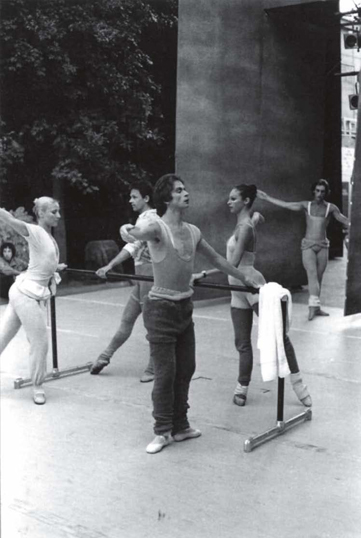
The chapter, "The Barre," details the ritual and work of professional dancers. Choreographer Rudi van Dantzig writes:

In America, in China, in Holland, In Russia, in Australia; about ten o’clock in the morning all over the world, dancers take their positions at the barre, ready for another dancing day.

From there, hard and strenuous working hours begin. First, there is half an hour barre, then an hour center exercises: adagio movements, turns, balances, small jumps, beats, big jumps, and pointe-work.

When class is finished the dancers usually have a fifteen minute break for coffee, a giggle, or for using the empty studio space to go over some steps for themselves.

People who don’t know anything of a dancer’s profession usually are exhausted from just watching a class, and are astonished to learn that this is just the preparation for the real work, which, if there is no performance, will go on until five or six o’clock. The real work means rehearsing and “cleaning” of old ballets in the repertoire, and the constructing, the searching and the experimenting with a choreographer on a new piece, the next ballet-to-be.

But at the barre it all begins...
Download the sample chapter here. And stay tuned: New, exclusive online chapters—ones available not even in the print edition of the book—will appear soon!

Nureyev book, Life Behind the Metaphor, now on sale!

Roger Urban's book of rare photographs of ballet legend Rudolf Nureyev, Life Behind the Metaphor, is officially on sale, beginning this week! Visit www.nureyevlegacy.com to order your copy today.

The vital information from the web site:

Featuring more than 80 exquisite duotone photographs, and printed using a stochastic process and inks developed for Ansel Adams, this unique limited-edition collector’s item may be the finest book of Nureyev photography ever created. These previously unpublished photos of Nureyev in performance and behind the scenes reveal the majesty of this master dancer as never before.

With text on the creative process of ballet written by Dutch National Ballet Artistic Director and Choreographer Rudi Van Dantzig; a preface by Madeleine Nichols, Curator Emerita of the New York Public Library for the Performing Arts; and a concluding essay on photography and dance by Richard Benson, Dean of Yale University School of Art, Life Behind the Metaphor is the perfect gift for any ballet enthusiast.

As a special bonus, the first printing of Life Behind the Metaphor includes a deluxe lithograph, signed by the photographer and suitable for framing.

For your part in supporting our donation of rare photographic materials to the New York Public Library for the Performing Arts, $30 of the purchase price of this book is tax-deductible.

(By the way—it makes a great gift for dance teachers and ballet students.)

Nureyev and the Red Sox

While reading some commentary about Joan Acocella's review of Nureyev: The Life, I came across this (older) link to a blog post that muses on Nureyev's ability to "pause" in mid-air, and its similarity to a catch made by Boston Red Sox Center Fielder Coco Crisp.

Robert Greskovic to interview Julie Kavanagh at Lincoln Center

This Saturday, October 6, at 3PM, the New York Public Library will host the program, "Nureyev and Shakespeare: Julie Kavanagh in Conversation with Robert Greskovic." (Greskovic, of course, is the noted Wall Street Journal ballet critic who commented that Roger Urban's shots were "the most clear in-performance photographs of Nureyev I have seen to date.")

The NYPL says that the free event "will feature screened excerpts of Nureyev in ballets of works adapted from Shakespeare."

The event will be held at the Bruno Walter Auditorium, The New York Public Library for the Performing Arts, 40 Lincoln Center Plaza, New York, NY 10023-7498.

Is Ballet "mindless?"

Part of John Carey's recent review of Julie Kavanagh's Nureyev: The Life for The Times has sparked a tiny tempest. In struggling to explain why he found Kavanagh's book wanting, Carey writes the following:

It should be a joy to read. So why is it not? The fault lies in [Kavanagh's] subject. Describing ballet in words comes down, essentially, to long, precise accounts of where people put their arms and legs, and this has severe limitations as reading matter. Further, ballet is mindless compared to other arts – as mindless as, say, football – and this restricts what can be written about it. Despite its fusillade of detail and its grand narrative sweep, Kavanagh’s book does not contain, in all its 800 pages, a single idea – not, that is, a single new or interesting thought about the physical or metaphysical universe. It is impossible to imagine the biography of a novelist or a painter or a scientist about which this could be said. But with ballet it is difficult to avoid, and the consequence is, intellectually, a howling wilderness, swept by gales of trivia, scandal and society gossip.
Writer and reviewer John Appleyard posted this on his blog in response:
John Carey says a very odd thing in his review of a biography of Rudolph Nureyev - 'Ballet is mindless compared to other arts - as mindless as, say, football - and this restricts what can be written about it.' It's odd because I don't know what he means by 'mindless'. A great deal of mind goes into football and an incredible amount, some of it quite lucid, can be written about it. Much more mind would seem to go into ballet and much more can be written, most of it very lucid, about it. Perhaps he means ballet provides a more visceral hit than most arts. But that isn't true either. All art has to be, to some extent, visceral to work at all. Perhaps he means ballet is very abstract. But some is and some isn't and, anyway, abstraction is easily written about. I give up. Can somebody tell me what Carey is on about?
To argue that ballet does not require an extraordinary amount of mental effort and constant analysis of technique and performance to achieve even a rudimentary level of proficiency (let alone world-class status) seems like a foolhardy proposition. So let's assume Carey doesn't mean that.

Setting that aside, then, it seems to me that the crux of Carey's point is this comment:
Kavanagh’s book does not contain, in all its 800 pages, a single idea – not, that is, a single new or interesting thought about the physical or metaphysical universe. It is impossible to imagine the biography of a novelist or a painter or a scientist about which this could be said.
Not to defend Kavanagh's writing (I haven't read her book, yet), but is not the idea that Nureyev's life embodies—the idea that excellence and transcendence can only be achieved through total devotion to one's art, despite the consequences to one's personality and personal relationships—an interesting thought? It worked for Faust.

Thanks to Brendan McCarthy for links and commentary.


LATE ADDITION:

Carey is not alone in his thoughts about the "mindlessness" of ballet. Just spotted this in Joan Acocella' review in The New Yorker:
It seems to me, for example, that there was a connection between Nureyev’s lack of moral feeling and the general unintelligence of his work—both his performances and his productions. And just as he had an entourage of yes-men, or yes-women, standing between him and the world, so there was a huge cliché machine surrounding him, an endless flow of effusions about how he was a lion, a tiger, a wild thing. Nureyev, and the “Nureyev phenomenon,” did not appeal to our higher instincts.
Acocella, at least, seems to confine the "mindless" judgments to the work of Nureyev alone, and not to all ballet.

Nureyev, the bridge between east and west, classical and modern

Norman Lebrecht reflects both on Nureyev's part in creating the template for modern celebrity, and on his artistic contributions, in "How Nureyev played the fame game," over at La Scena Musicale. I liked this observation:

A repository of Russian traditions with an elephantine memory for steps, Nureyev reached out to choreographers in Amsterdam and New York, acting as the single most important bridge between classical and modern dance.

Bucketful of Nureyev and Kavangah

There has been a pile of coverage—and excerpts—about Julie Kavanagh's Nureyev: The Life. Here's a lengthy rundown:

Excerpts:

  • "Nureyev in love:" The biographer of the world’s greatest dancer reveals that beautiful women – not men – were his first passion (The Times)

  • "Did Rudolf Nureyev and Margot Fonteyn have an affair or didn’t they?" From the start of their hot stage partnership rumours were rife that Nureyev and Fonteyn were having an affair. It is a question that still divides their friends (The Times)

  • "The purest and the dirtiest" From Shakespeare, to the Russian poets, to JD Salinger, Rudolf Nureyev was a passionate reader. But no one inspired the dancer more than his Romantic hero and alter ego, Byron (The Guardian)


Reviews
  • John Carey (The Times)

  • Peter Conrad (The Observer) "The beast within the beauty:" Julie Kavanagh's Rudolf Nureyev reveals a peerless dancer and entrancing character but also a deeply unattractive man

  • Lynn Barber (The Telegraph) "Very hot and very rare" [en entendre referring to how Nureyev liked his steaks]

  • Joan Acocella (The New Yorker) "Wild Thing:" Rudolf Nureyev, onstage and off.

  • Tobi Tobias (Bloomberg) "Nureyev, Passionate Rebel With Great Legs, Found Fame in Exile"

  • Joel Lobenthal (New York Sun) "What Made Rudolf Nureyev"

  • Simon Callow (The Guardian) "James Dean in tights:" Julie Kavanagh's Rudolf Nureyev reveals a supreme commitment to art that is an example to us all [Here's Callow's ending to the piece:]
    Kavanagh never apologises for him, nor does she try to extenuate his frequently brutal behaviour. What she makes clear is that these were flaws in a titanic human being who never ceased to strain every fibre of his being to serve dance. For him there was never any comfort zone. To be a dancer, he said, was "sacrificial work". Kavanagh's book, apart from its comprehensive and compulsively readable account of Nureyev's life and art, and its exceptional lucidity about the history and technique of dance, is an important wake-up call to the lily-livered rest of us: this is what performing can be, but only if we give it everything. Nothing less will do.
Whew! Exhausted yet? As blogger Gayle Alstrom noted (about Joan Acocella's review):
Reading this wonderful extensive review that seemingly tells as much about Nureyev that any normal person would want or need to know, I can't see any reason to read the book...
With all the coverage, we may be in some Nureyev: The Life overload.